Make AI grow on every device
Three independent product lines — full-stack on-device continual learning infrastructure, a multi-AI collaboration harness, and inference visualization — for developers and researchers making models grow with their users, on the device.
import EdgeInference

let engine = LLMEngine()
try await engine.load(config: .find(
    modelID: "qwen3.5-4b"
)!)

for try await chunk in engine.generate(
  messages: [.user("What is edge AI?")]
) {
  print(chunk.text, terminator: "")
}
5 lines — load a model, stream tokens
Product Line 01
Edge Suite
Developer PreviewFull-stack infrastructure for on-device continual learning — built for developers making models grow with their users, on the device. From the inference kernel to model evolution, device mesh, and app shipping, every layer is ours.
Full-Stack Ownership
From inference kernel to agent shipping — every layer is ours
Cloud AI can't — they sell compute. Open source can't — nobody else controls all five layers. Data never leaves the user's device. Shipping on Apple and Intel: developer tools target Apple today, and our Intel runtime has shipped to a world-leading PC manufacturer.
Continuous Learning
Patented HALO AlgorithmThe industry is exploring how to make models learn continuously. We shipped it on-device.
Google, OpenAI, and Anthropic are all researching how to make models grow with users — but their approaches require cloud infrastructure and data uploads. Built on our patented HALO algorithm system, Edge Halo puts the entire evolution loop on the user's device: from behavior collection, profile extraction, learning-state consolidation, to real-time steering. Data physically never leaves the device.
User interactions stored locally, encrypted on device
Extract the user's preference geometry — not keywords, but directions in activation space
Consolidate the profile into Neural Imprint learning state on the device — no weight updates, no fine-tuning
Inject into inference in real-time, no model reload needed
User can revert to the base model at any time
Cloud vs On-Device
The Edge Suite
Edge Engine
Native Metal runtime for Apple SiliconPurpose-built inference runtime. Metal command scheduling, tensor abstractions, model-family implementations. Foundation for Edge Kit.
Currently runs on: iOS 17+ · macOS 14+ · Apple silicon (A- and M-series)
Edge Kit
Swift SDK for on-device AIComplete inference SDK supporting LLM, VLM, ASR, and TTS. Streaming output, multi-turn conversation, automatic memory management, and capture and restore of Neural Imprint learning state.
Currently runs on: iOS 17+ · macOS 14+ · Apple silicon (A- and M-series)
Edge Halo
Model self-evolutionModels that grow with users. User profiling, Neural Imprint learning-state lifecycle (compatibility checks, restore, rollback), real-time activation steering. All data stays on-device.
Currently runs on: iOS 17+ · macOS 14+ · Apple silicon (A- and M-series)
Edge Mesh
Private device meshA local mesh between a user's own devices. An iPhone can hand inference and other heavy work to the Mac on the same network and get the results back, and training artifacts flow between devices the same way — with no cloud in the path.
Currently runs on: iOS 17+ · macOS 14+ · Apple silicon (A- and M-series)
Edge Scaffold
From model to App StoreiOS app template. One config file, automatic device detection, four-tier model delivery. From optimized model to published app in minutes.
Currently runs on: iOS / iPadOS 18+ · Apple silicon (A- and M-series)
Edge Studio
Model optimization workbenchAnalyze, optimize, benchmark, and export models. 117+ architectures, device-specific recommendations, one-click app generation.
Currently runs on: macOS · Apple silicon (M-series)
Benchmarks
Not slides — real devices, real models, real numbers
Qwen3.5-9B-4bit, 200-turn continuous conversation stress test, metrics recorded per turn.
9B Model · 200-Turn Conversation · Per-Device
| Device | Chip | RAM | First | Avg | Last | TTFT |
|---|---|---|---|---|---|---|
| iPhone 17 Pro | A19 Pro | 12G | 13.6 | 11.5 | 11.4 | 496ms |
| iPhone Air | A19 Pro | 12G | 9.1 | 8.2 | 8.75 | 868ms |
| iPad Air M3 | M3 | 8G | ~9 | 9.1 | 9.06 | 2192ms |
TPS = tokens/sec · TTFT = mean time to first token · Qwen3.5-9B-4bit · iPad Air M3 ran 2048 tokens/turn with context compaction; others 1024 tokens/turn
Custom Engine vs Generic Framework
M2 Ultra 192GB · Baseline: mlx_vlm (Python MLX)
Product Line 02
AI Collab
Open Source · MITmacOS 14+A native macOS app and local Host that run multiple AI coding agents on one Git project: task rooms with isolated workspaces, one Host-owned terminal window per colleague, typed policy-routed deliveries with consumption receipts, and rooms that close and resume.
What It Does
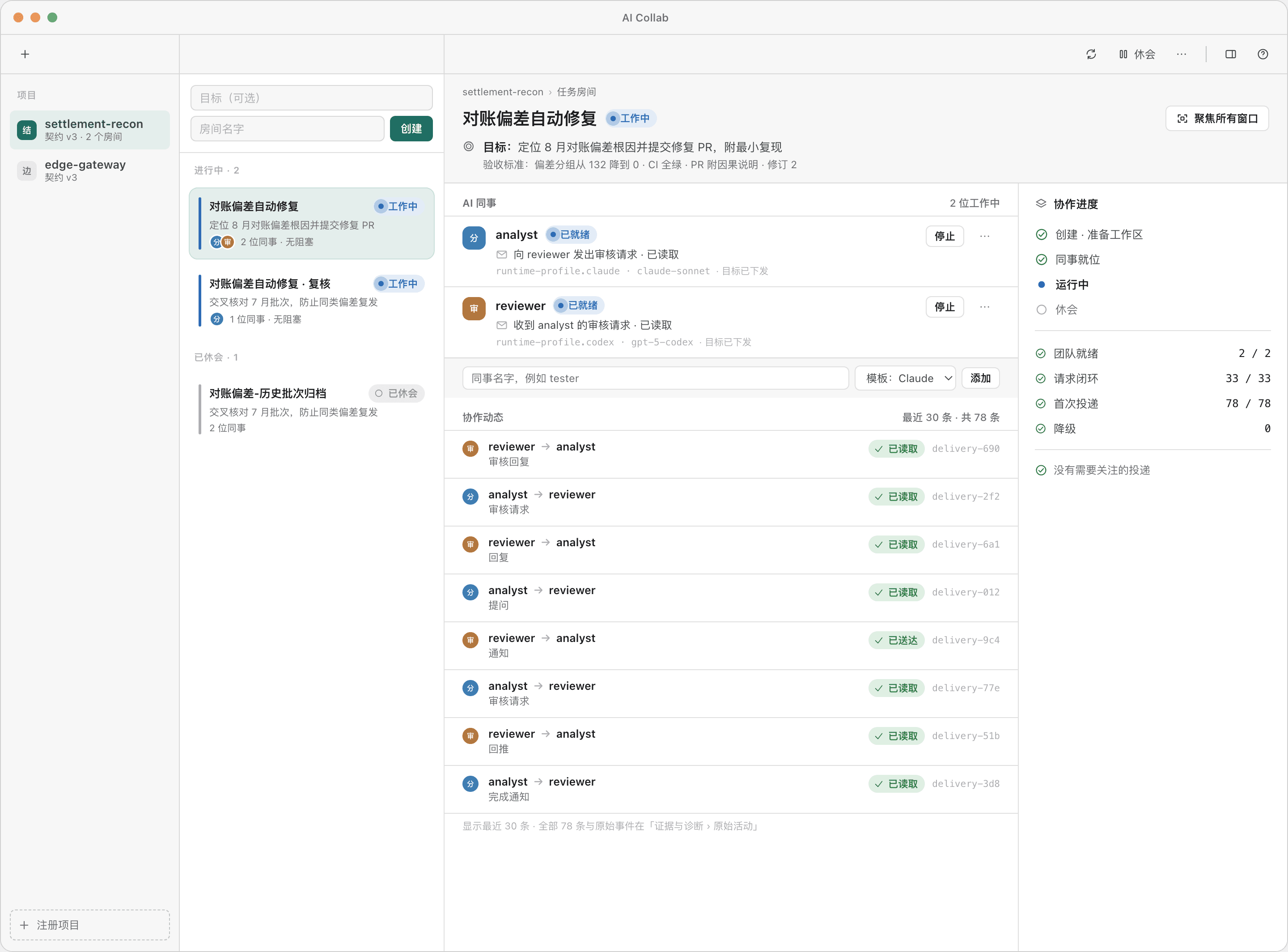
The App is the primary entry — the CLI serves automation
Product Line 03
Vanilla
AvailablemacOS · Apple silicon (M-series)Real-time visualization of large language model inference for researchers, learners, and educators. v1.0.4 adds VLM image input, model discovery, faster visual rendering, animated transitions, and error recovery.

Shipped · Powered by Edge